Retail media and commerce media are often used interchangeably. Both connect advertising to commercial outcomes and draw on audience and shopping signals, but their applications and scope are not identical.
Retail media has established itself as a powerful advertising channel, connecting brands with consumers through retailers’ audiences, data and media environments. As the industry evolves, commerce media is emerging as a broader framework for connecting media exposure with commercial outcomes across the customer journey.
The boundaries between the two are not always clear-cut. Retail media is widely considered an important part of the wider commerce media ecosystem, with both continuing to evolve as advertising, content and commerce converge.
What Is Retail Media?
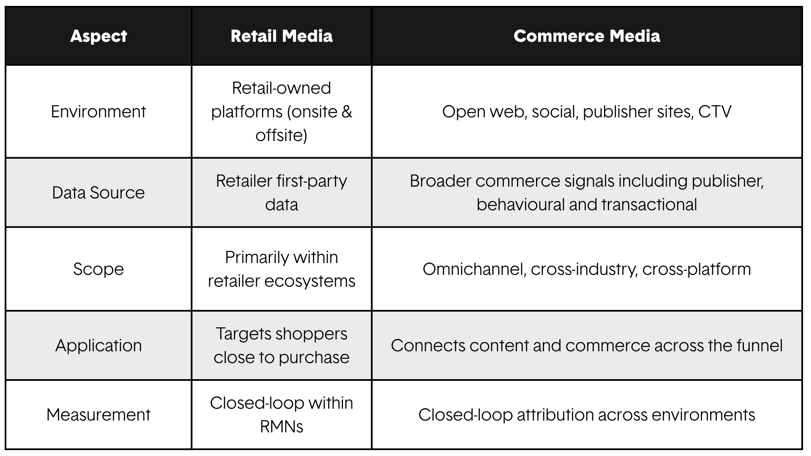
Retail media enables advertisers to reach audiences using retailers’ media environments and first-party shopper insights. These opportunities include sponsored search results and product listings, digital displays and signage in stores, retailer-owned websites and apps, and offsite campaigns delivered through publishers, social channels and connected TV.
Retail media’s traditional strength is its proximity to purchasing decisions. Retailers understand how consumers explore and buy products, helping advertisers connect relevant messaging to shopping activity.
Retail media networks (RMNs) bring together inventory, audiences, data, technology and measurement capabilities. A key advantage of retail media networks is their access to first-party shopper and transaction data, enabling advertisers to draw more direct connections between media activity and purchase outcomes. While closed-loop measurement has long been a compelling part of retail media’s value proposition, the industry is increasingly looking beyond attributed sales towards incrementality: understanding whether advertising is generating additional purchases that would not otherwise have occurred.
As retail media networks expand across more channels and environments, the opportunity to demonstrate genuine commercial impact becomes increasingly important. However, measurement capabilities and methodologies continue to evolve, with the challenge shifting from measuring performance within individual channels to understanding advertising’s contribution across the broader customer journey.
What Is Commerce Media?
Commerce media takes a broad view of how advertising, data, content and commercial interactions relate. It can encompass retail media, as well as opportunities arising through publishers, platforms and other organisations that connect audiences with products and services.
For example, a publisher’s product feature could include an interactive experience that allows readers to explore available options and begin a purchase. A connected TV campaign could use an on-screen prompt to move interested viewers towards a transaction.
As commerce experiences expand across different media environments, the opportunity to connect engagement with measurable shopping activity becomes increasingly valuable. Technology providers such as Vudoo can play an important role in bridging traditionally siloed channels, enabling interactive, transactable experiences and more consistent measurement of consumer engagement and commerce outcomes across supported environments.
The potential is not limited to retailers. Travel, telecommunications, automotive, entertainment and other sectors are also exploring how media experiences can support measurable commercial action.
Retail media has traditionally been associated with the lower funnel, capitalising on its proximity to the point of purchase to reach consumers with high purchase intent. But that perception is evolving. As retail media networks expand into offsite advertising, connected TV and broader brand-building opportunities, retail media is increasingly playing a role across the customer journey, from awareness and consideration through to conversion.
Commerce media takes a broader view of the relationship between media and commerce, exploring how content, advertising and shopping experiences can connect across environments, audiences and stages of the purchase journey.
Which One Is Right for Your Brand?
The answer depends on the audience, the business objective and the media environments best suited to the opportunity. These are not necessarily competing strategies.
Retail media can be especially useful if:
You want to reach shoppers through retailers’ audiences and media environments.
Your plans involve relevant onsite, offsite or in-store placements.
You value retailer first-party insights and opportunities to assess sales outcomes.
Commerce media offers broader opportunities if:
You want to connect shopping opportunities with media and content across more environments.
You want to explore new ways to turn consumer engagement into measurable commercial action.
You’re looking to reduce friction between discovery, consideration and purchase throughout the customer journey.
For most brands, the opportunity isn’t about choosing between retail media and commerce media. It’s about understanding how the two intersect and how different media environments, audience insights and commerce technologies can work together to support business objectives. As traditional boundaries between media channels and shopping experiences become less distinct, brands have greater opportunities to connect attention, engagement and transactions.
As retail media networks continue to expand their reach and capabilities, the boundaries between advertising and commerce will become increasingly fluid. The opportunity ahead lies in connecting these experiences more effectively, reducing friction between engagement and purchase, and making more of the moments that influence commercial outcomes.